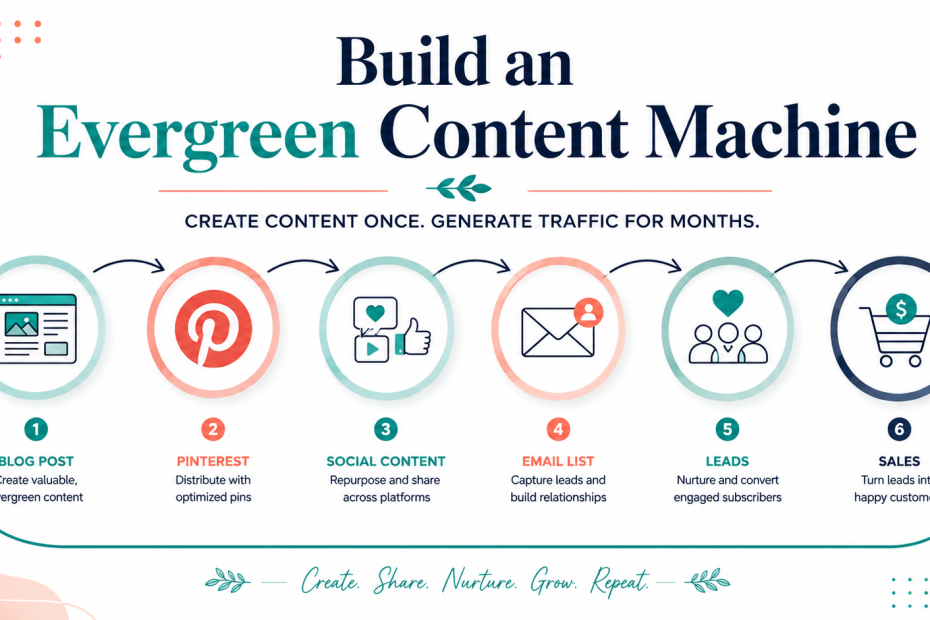
Create content once and generate traffic for months.
Most creators, consultants, and small business owners have the same problem: they spend hours creating content that disappears within days.
A social media post gets a few likes, a video receives a temporary spike in views, and then everything resets. The next day, the pressure to create again starts all over.
This cycle is exhausting because most content platforms are built around recency. If you stop posting, visibility often disappears.
But there is another approach.
Instead of building a content strategy that depends on constant publishing, you can build an evergreen content machine—a system designed to generate traffic, leads, and opportunities long after the content is published.
The goal isn’t to create more content.
The goal is to create assets that continue working while you focus on other areas of your business.
This is where blogging, Pinterest marketing, content repurposing, and traffic systems come together.
What Is an Evergreen Content Machine?
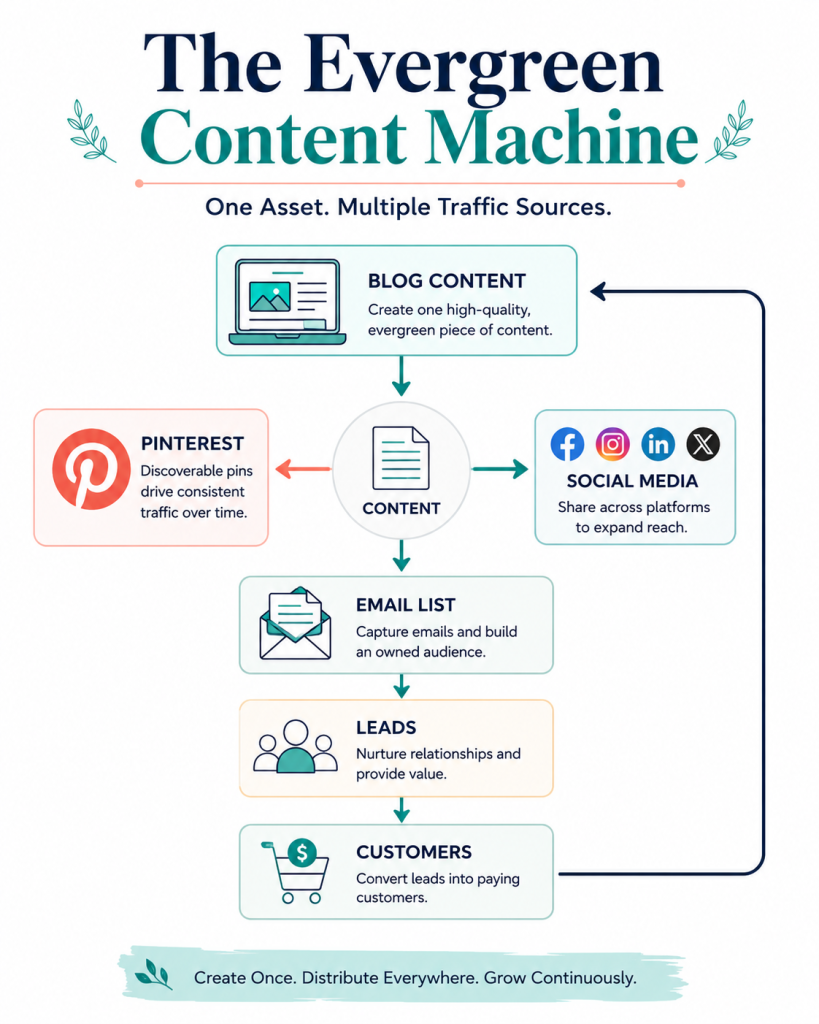
An evergreen content machine is a content ecosystem that continuously attracts visitors over time without requiring daily effort.
Unlike short-lived content, evergreen content remains relevant and searchable for months or even years.
Examples include:
- How-to guides
- Tutorials
- Industry frameworks
- Case studies
- Resource lists
- Comparison articles
- Frequently asked questions
- Strategic playbooks
The content machine works because each piece supports the others.
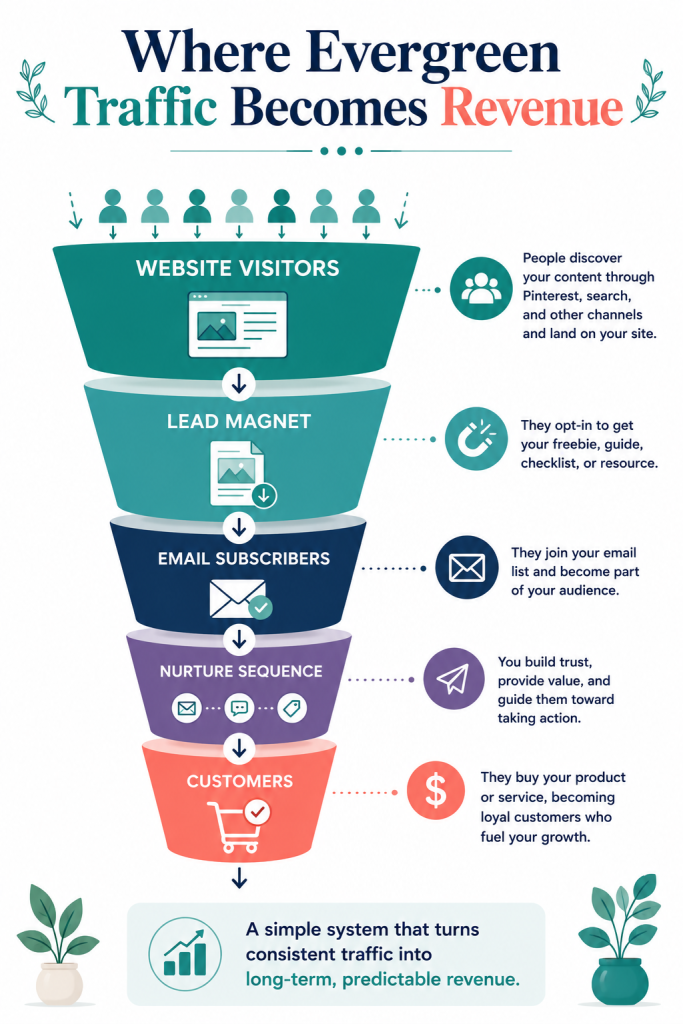
A blog article attracts search traffic.
Pinterest distributes the article to new audiences.
Repurposed content expands reach across multiple platforms.
Lead magnets convert visitors into subscribers.
Email automation nurtures relationships and drives conversions.
Instead of isolated content pieces, you create a connected system.
Why Most Content Strategies Fail
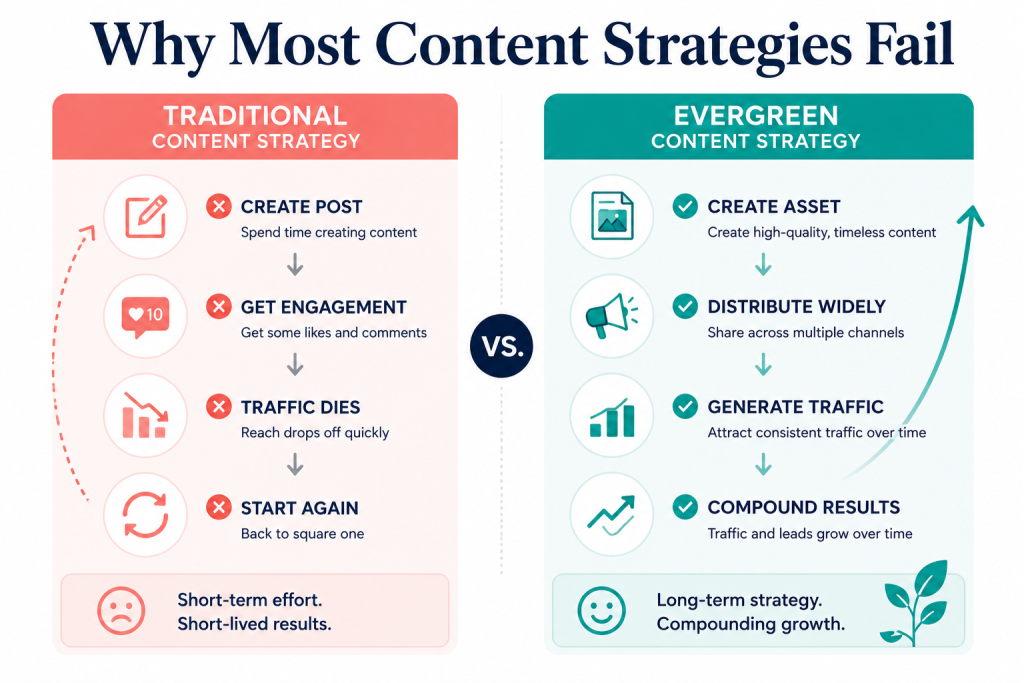
Many businesses approach content backwards.
They begin with platforms instead of assets.
They focus on:
- Posting daily
- Chasing trends
- Following algorithms
- Creating endless short-form content
The result is constant activity with little long-term return.
Every post has an expiration date.
Evergreen systems work differently.
Rather than asking:
“What should I post today?”
You ask:
“What asset can I create that will still be valuable six months from now?”
That single shift changes everything.
The Four Layers of an Evergreen Content Machine
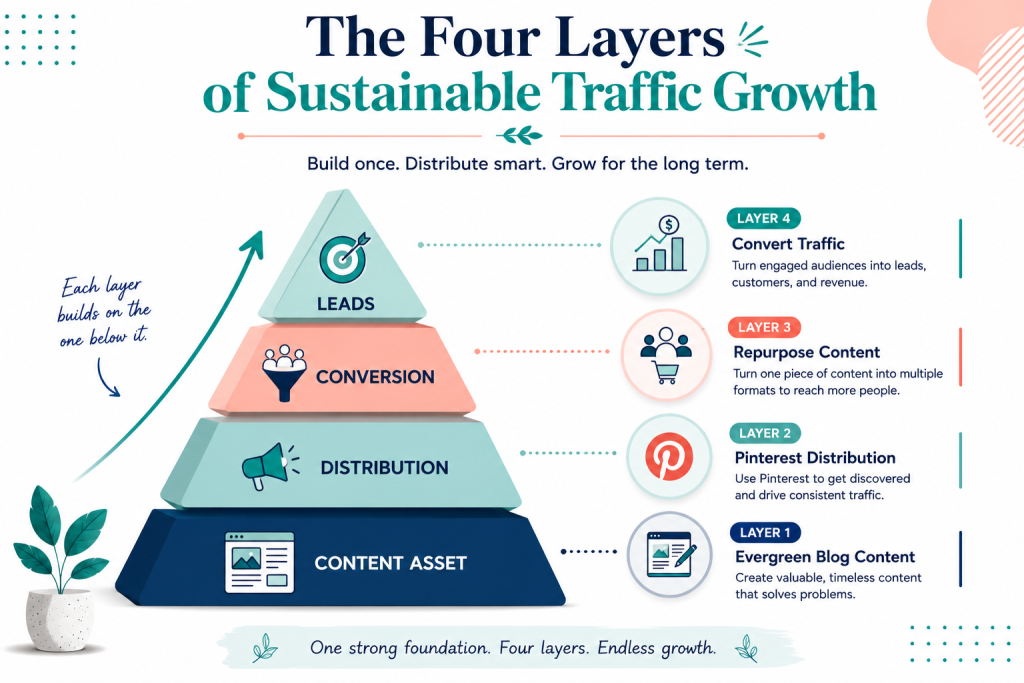
Think of your content system as four connected layers.
Layer 1: Create a Searchable Content Asset
The foundation is a high-quality blog post.
A blog gives you something social platforms cannot provide: ownership.
You control the content.
You control the traffic destination.
You control the conversion process.
The best evergreen articles solve specific problems.
Examples include:
- Pinterest Marketing for Beginners
- How to Create a Sales Funnel That Converts
- Email Automation Workflows Every Small Business Needs
- SEO vs Pinterest Traffic: Which Should You Focus On?
Focus on topics people actively search for rather than topics you simply want to discuss.
Good evergreen content is demand-driven.
Before writing, identify:
- Search intent
- Common questions
- Industry pain points
- Desired outcomes
A useful article solves a problem better than competing resources.
Depth matters more than length.
The objective is completeness, clarity, and practical application.
Layer 2: Use Pinterest as a Distribution Engine
Many marketers still misunderstand Pinterest.
Pinterest is not primarily a social media platform.
It functions more like a visual search engine.
People visit Pinterest looking for solutions, ideas, guides, and recommendations.
That intent makes it uniquely valuable for evergreen content.
Unlike posts on traditional social platforms, Pinterest content can continue generating impressions and clicks months after publication.
This is why Pinterest often performs exceptionally well for:
- Bloggers
- Coaches
- Consultants
- Course creators
- Service businesses
- E-commerce brands
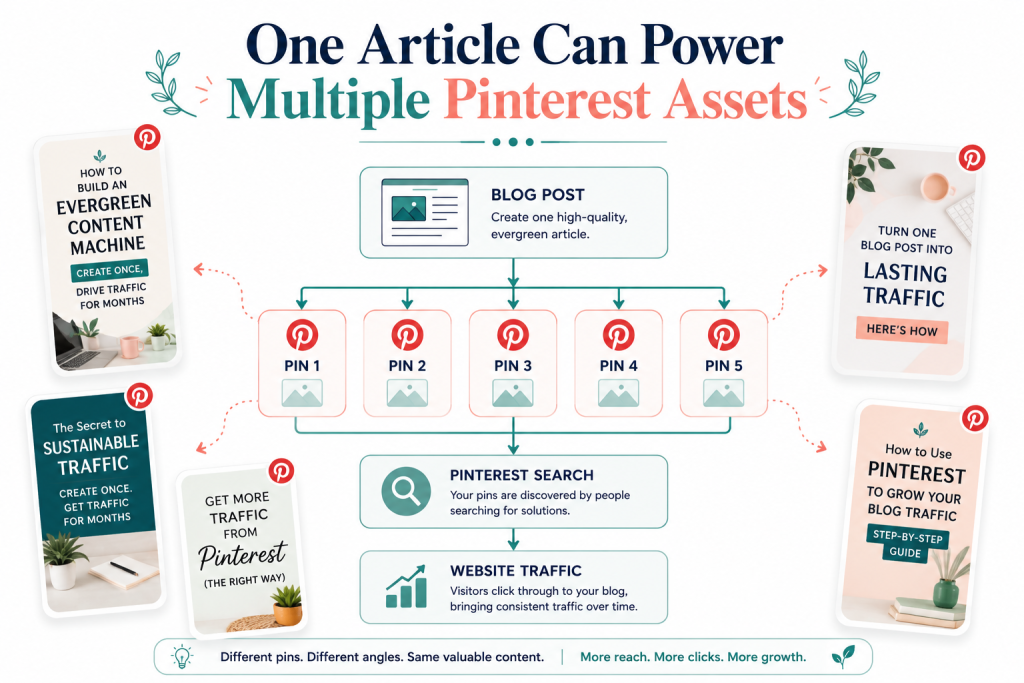
The process is straightforward:
- Publish a blog post.
- Create multiple Pinterest pins.
- Link every pin to the article.
- Optimize titles and descriptions with relevant keywords.
- Continue creating new pin variations over time.
Instead of promoting a blog post once, Pinterest allows you to continually resurface the same content through fresh creative assets.
One article can support dozens of pins.
One pin can drive traffic for months.
Layer 3: Repurpose Every Content Asset
One of the biggest mistakes creators make is treating content as a one-time activity.
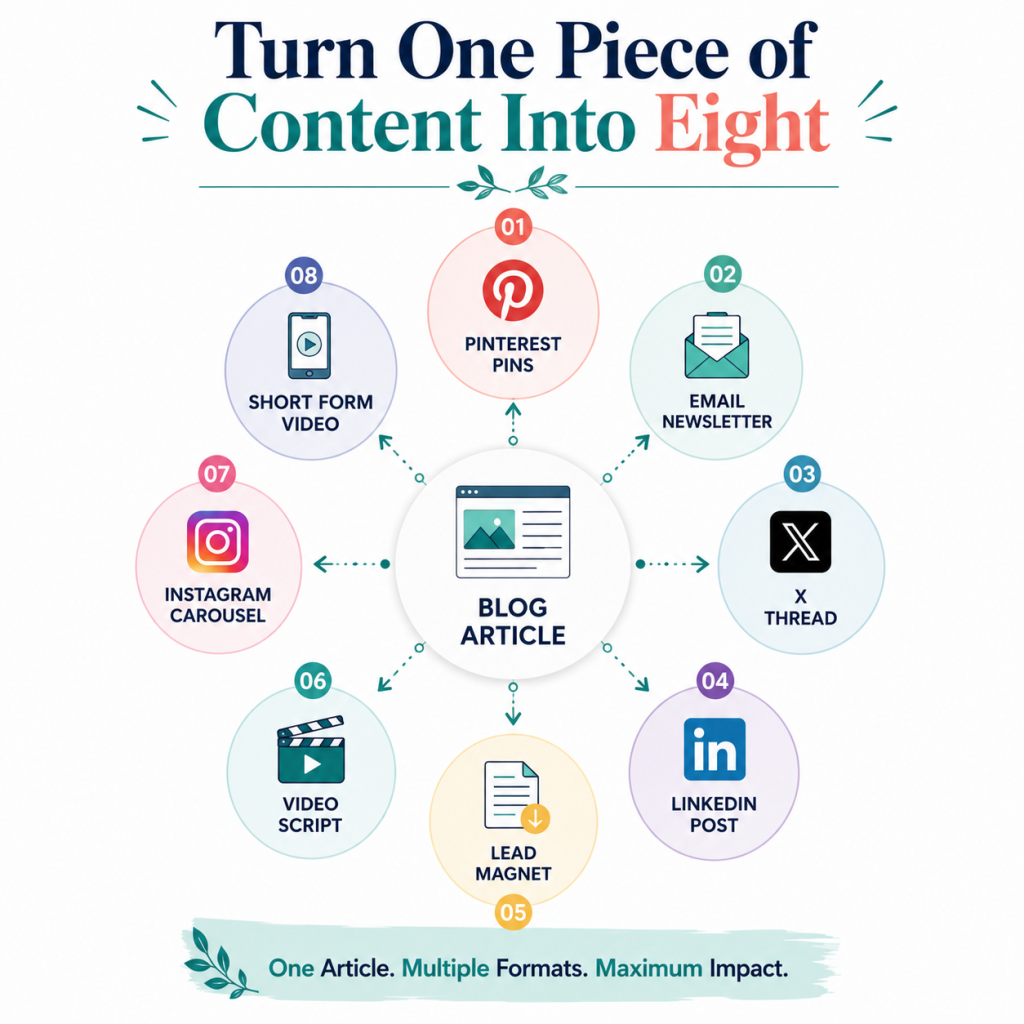
A single article should generate multiple content pieces.
For example:
One Blog Post Can Become:
- 10 Pinterest pins
- 5 social media posts
- 3 email newsletters
- 1 long-form LinkedIn article
- 1 X thread
- 1 video script
- 1 lead magnet
- Multiple short-form clips
This approach dramatically increases content efficiency.
Instead of creating 20 separate pieces of content, you create one core asset and distribute it in multiple formats.
This is how modern content teams maximize output without increasing workload.
The best content marketers are not necessarily creating more.
They are repurposing better.
Layer 4: Convert Traffic Into an Owned Audience
Traffic alone does not build a business.
You need a system that captures and nurtures visitors.
This is where lead generation becomes essential.
Every evergreen article should contain a logical next step.
Examples include:
- Checklists
- Templates
- Guides
- Worksheets
- Swipe files
- Resource libraries
When visitors exchange their email address for a valuable resource, you transform anonymous traffic into a business asset.
This is where long-term growth happens.
Algorithms change.
Email lists remain.
Building Your Evergreen Content Workflow
An evergreen content machine does not require publishing every day.
It requires consistency.
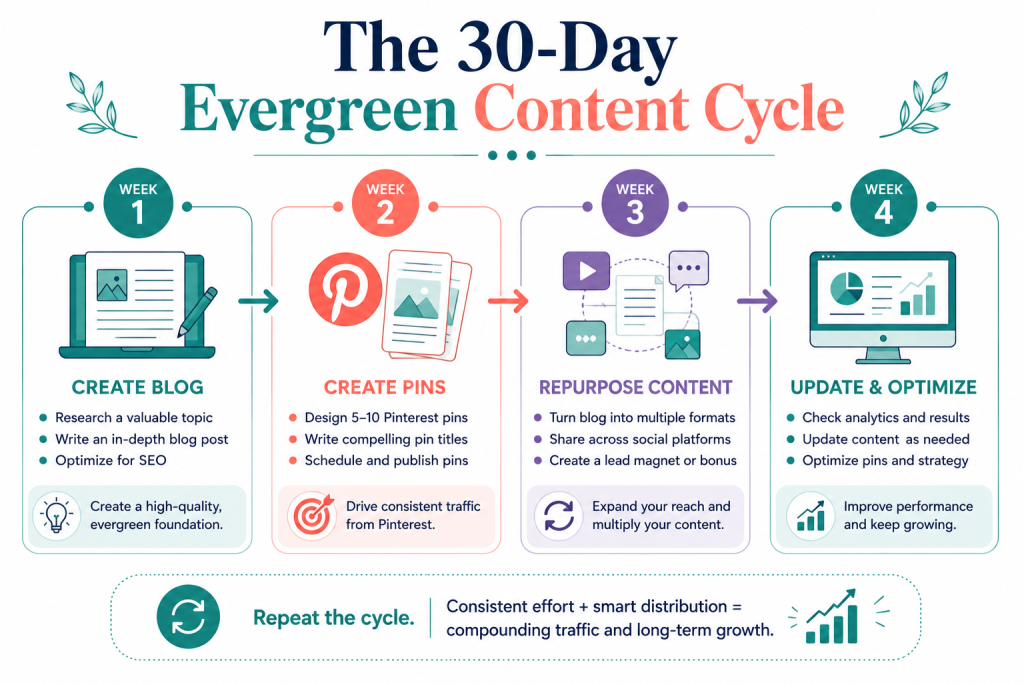
A simple monthly workflow might look like this:
Week 1
Research and publish one comprehensive blog post.
Week 2
Create 10–15 Pinterest pins linking to the article.
Week 3
Repurpose the article into emails, social posts, and short-form content.
Week 4
Review analytics and update existing content.
Then repeat.
Over time, your content library expands.
Traffic compounds.
Lead generation becomes more predictable.
The system grows stronger with every asset you publish.
The Power of Content Compounding
Most people underestimate compounding.
They expect immediate results.
Evergreen systems reward patience.
A single article may attract:
- 100 visitors in month one
- 300 visitors in month three
- 1,000 visitors in month twelve
Now multiply that by 20, 50, or 100 articles.
The traffic does not reset every month.
It accumulates.
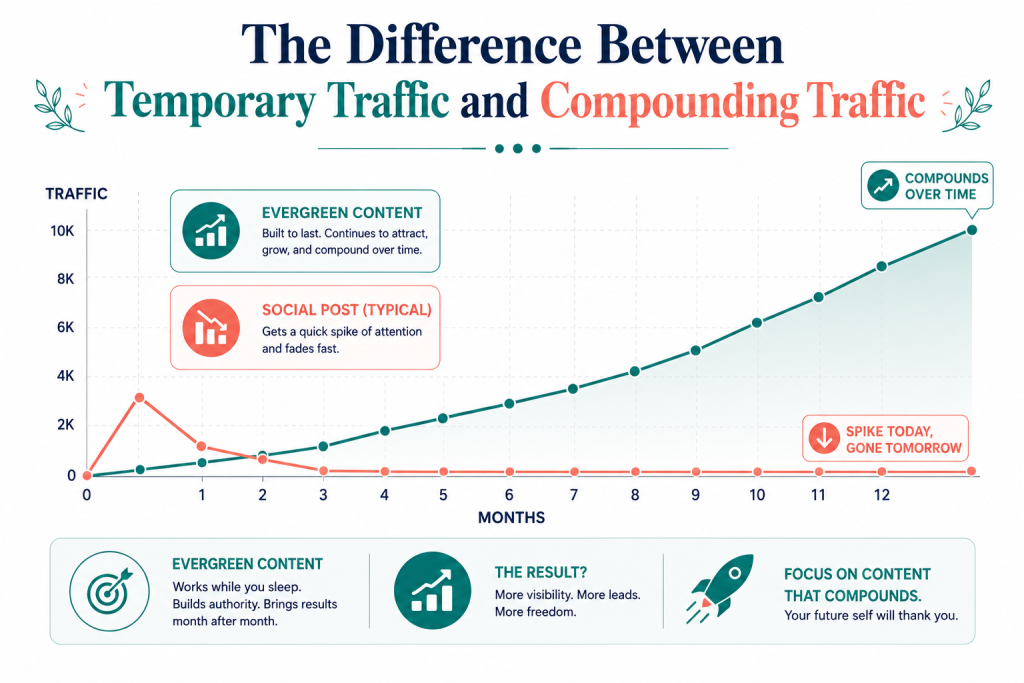
This is why established blogs often outperform newer competitors despite publishing less frequently.
Their content library continues generating results.
Each asset becomes another entry point into the business.
Common Mistakes That Kill Evergreen Growth
Publishing Without Distribution
Creating content is only half the job.
Without distribution channels such as Pinterest, search engines, email marketing, and social media, even great content can remain invisible.
Chasing Trends Exclusively
Trending content can generate short bursts of attention.
Evergreen content generates sustainable growth.
A balanced strategy prioritizes evergreen assets and supplements them with timely content.
Ignoring Content Updates
Industries change.
Statistics become outdated.
Tools evolve.
Reviewing and refreshing important articles periodically helps maintain rankings, credibility, and engagement.
Creating Content Without a Conversion Path
Traffic should have a destination.
Every article should guide readers toward a logical next step.
Without conversion systems, traffic remains a vanity metric.
The Future of Evergreen Content
As content creation becomes easier and more accessible, quality and distribution become increasingly important.
Businesses that win over the next few years will not necessarily be the ones producing the most content.
They will be the ones building systems.
The combination of blogging, Pinterest marketing, content repurposing, email automation, and lead generation creates a durable growth engine that is less dependent on trends and algorithm changes.
That is the real advantage of an evergreen content machine.
It allows you to stop starting from zero every day.
Instead, each piece of content becomes another asset working on your behalf—attracting traffic, generating leads, and creating opportunities long after you hit publish.
Final Thoughts
The most successful content strategies are not built around constant creation.
They are built around leverage.
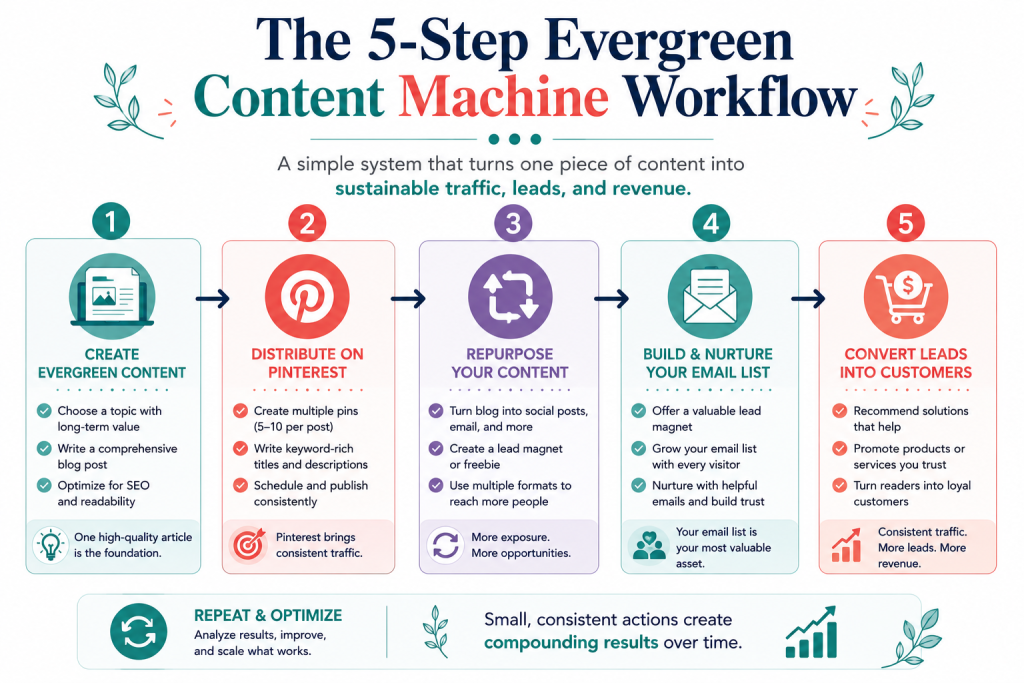
Create a valuable blog post.
Distribute it through Pinterest.
Repurpose it across channels.
Convert visitors into subscribers.
Automate follow-up.
Then repeat.
Over time, these assets compound into a traffic system that continues generating results long after the work is done.
That is the difference between creating content and building an evergreen content machine.